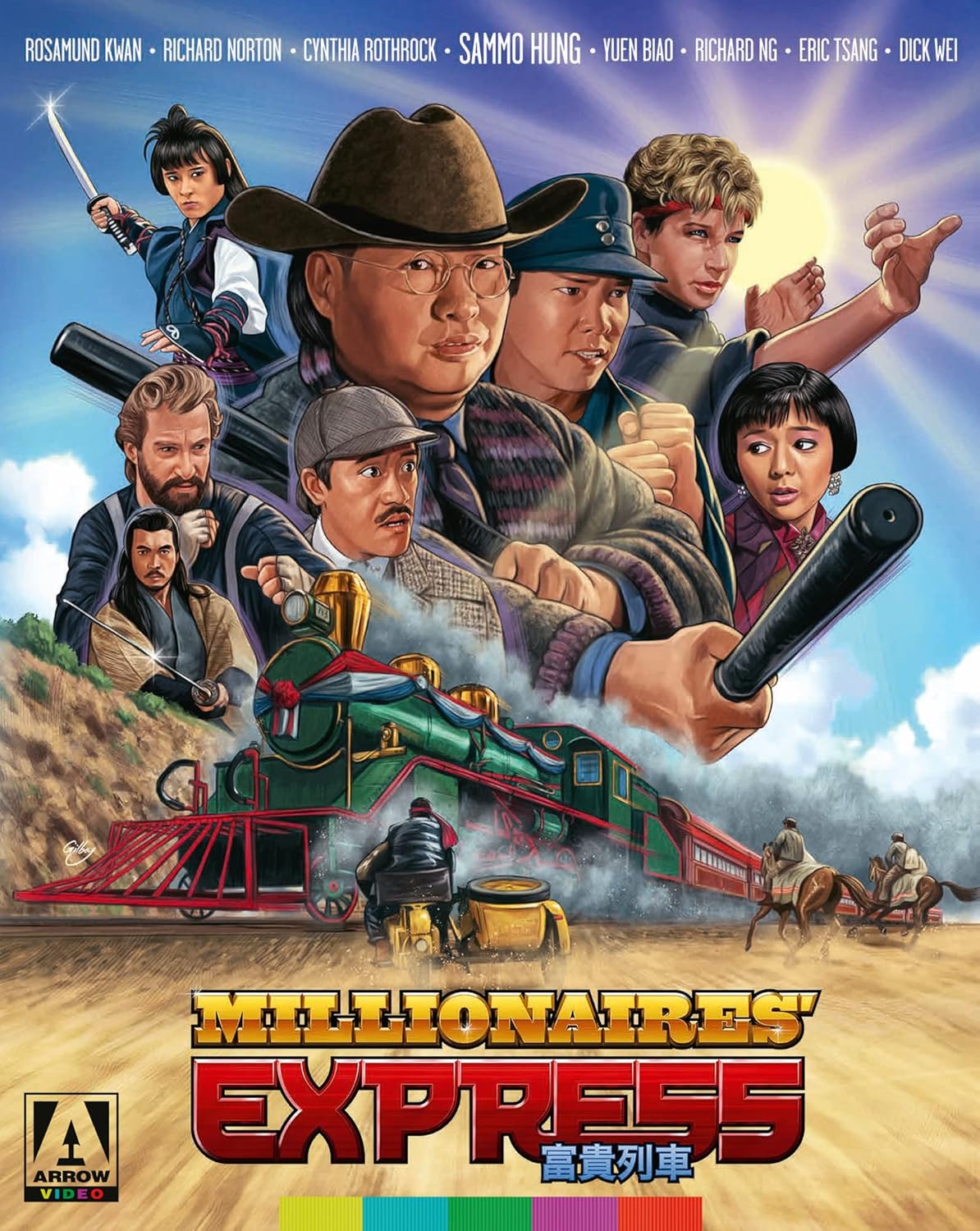
Hang on to your ill-gotten goods, because Millionaires’ Express (1986) is the Greatest Movie EVER!
Click on the Blu-ray cover or the title above to download our review of the film, featuring guest host Daryl Surat of AnimeWorldOrder.
Review in a Nutshell: A slapstick comedy with an extensive cast list and some truly jaw-dropping fight scenes and stunts, Millionaires’ Express (1986) is an unusual, one-of-a-kind film that defies expectations at nearly every turn.

 The Greatest Movie EVER! Podcast
Several thoughts. Feel free to skip or burn it to the ground as it is long, Proletarian Castro Stalin long. But I feel it today.
1) To give some context, M.E. is what’s called a Chinese New Year movie (not Lunar, please). These HK movies used to be a vehicle where tons of popular film/tv actors in effect are saying Happy New Year to the Chinese audience, be it HK, mainland, or oversea. Saying something auspicious to friends and family is a 3500 year old tradition traceable to the Shang Dynasty (more on that later). While I still see some on a smaller scale, arguably it has migrated to the annual Spring Festival Gala live broadcast. The Gala has for all intent and purpose become a new national tradition, not just actors from China, but HK, Taiwan, even oversea in America thanks to the internet. This giant production runs over 5 hours. The core program is the Central one, but it often includes equally gigantic sub-venue pieces from outer provinces and especially minority groups. Last year was a huge dance number from Xinjiang with the most beautiful woman in the world (my opinion of course) Dilraba Dilmurat. This year included a big one from Tibet (just in time for a pick-up-me because of the earthquake), Jiangsu and Hubei provinces, and even the giant city of Chongqing (in the West we call it Chungking…as in Chungking Express). Point is, the Gala has grown ridiculously huge over the year (currently the most watched single tv show in the world), with segments or whole thing can be see on line if people didn’t see it live. While live, some segments are pre-recorded (or combination of). I myself am particularly fond of education pieces (some call it propaganda here in the West) showcasing local or traditional craftsmanship). I’m not as familiar with some of these stars as I were with old HK ones from the 80s, but I have to say the talents are simply on another level. The only bad thing with the Gala compared to old New Year HK movies is about 1/4 of it are commercials (so much for anti-Capitalistic Reactionary Proletarian zeals…). Most people just have it on in the background and don’t pay any attention, but it has become a tradition.
2) Sammo has done many non fight roles: romance (“8 Ounces of Gold”, and “Paper Marriage”… wait, that has a great fight and the end… btw, Gerard Depardieu stole that story in one of his movies… except the fight…. the fat fk), a mental handicap, a eunuch, a drama where he plays a movie stunt coordinator along side with Michelle Yeoh (it was one of Yeoh’s big dramatic break away from fight movies), and a dramatization of his and Jackie Chan’s life in the opera school that they were indentured (he played his own stern teacher… very good movie… very heartfelt).
3) Daryl commented something about movies from China. Right now anything from mainland is taboo in the West. Games, movies, EVs, software, chips, Tiktok, Xiaohongshu, Deepseek, etc. If Cotton or Rubio has their way Singapore too. We in the West make all kinds of crazy accusations without proof, being on the ground, speak the language, or just allowing the Chinese to defend themselves. We take everything negative about China as godspoken truth… (hell, I was in that camp for about 30 years until the Ukraine war and Gaza and all the evil things we have been doing in the name of Hegemony… looking back at the millions of people we killed in the name of democracy, weapons of mass destruction, Gulf of Tonkin, compared to the number of countries China went to war with… ugh). Anyway, I shouldn’t get into politics, it just kinda slip… all I’m just saying right now the anime community in the US seems to intentionally ignore anything from the PRC. Even if the work is great rivaling Pixar or Japan or Capcom or whatever, no one talks about it on their platform even if it’s fully within their genre of interest. To that end I just want encourage you two to give some Chinese entries a shot. Here are 3:
1) Legend of Luo Xiaohei (they called it Legend of Hei here). There are a series of web anime, a major movie, and several comic books. The easiest entry is the movie. It also has a cameo by one of Chinese’s favorite gods Nezha (possibly based on a Hindu deity, but totally Sinofied. More on him below)
2) The big budget trilogy “Creation of the Gods”… though the 3rd movie wont’ be out till next year). The first one is available on various streaming platform, and the 2nd is out right now in China, and may even be in US theater in a month or so just like the first (I saw it in California last year).
The trilogy is a loose retelling of the original 16th Century novel “Investiture Of The Gods.” There have been many adaptations, but this trilogy (based only on the first one I saw) is arguably the best since I was a child in the 70s. While the novel is not as well regarded as say Journey to the West, the myth itself in some sense is the original story of the Chinese civilization.
The story goes back to the last days of the 500-year old Shang Dynasty circa 1000 BC. Shang is supremely important not only because it is referenced in The Shiji (circa 100 BC, think “Histories” by Herodotus… and a lot of BS just like Herodotus), it also led to some of the earliest Chinese thoughts regarding the universe (more below. Also, Shang is confirmed by several major archeological digs, unlike say the preceding Xia Dynasty prior 1500 BC. The Xia, though referenced in several texts, including unearthing of lots of pottery, castings, artifacts, writings albeit undecipherable, and possible remnants of some major water works, no definitive buildings or monuments were found, unlike the City of Ur for example. Personally I’m in the camp of the archeology as evidence is important, but lots of nationalistic Chinese feel the West is once again chaffing their hide (hahaha).
Historically, the fall of Shang as depicted in the book gave way to the Book of “Zhou-Yi”, later known as the “Yi-Jing”… aka the “I-Ching” or “The Book of Change” as it is known here in the West. (Note: the “I” is not pronounced “eye”, but “Yee”). The I-Ching codified existing concepts of Yin and Yang, the use of Trigram within the Eight Diagram aka Baqua divination process, some the most fundamental Chinese and arguably Asian thought of the universe. It also liberated people from the Shaman and the hold of the Shang. (Another note. Not only were the Shang mighty militarily, these guys also did a lot of fortune-telling using a huge number of human sacrifices… usually from neighbors… think all the Mayans and Aztecs several folds over a period of 500 years… and yes, lots of cannibalism… probably.) The idea is now the people outside of Shang can use the same divination with the “I-Ching”, and eventually, phasing out of Shamanism and most importantly, human sacrifices. Shamanism begins to die out by the time of Western Zhou Dynasty (1000 to 700 BC). And by the end of the Warring State, under unification of the First Emperor of Qin circa 3rd Century BC, various supernatural elements are no longer tolerated in Court… The Court can tolerate only one religion, that the emperor is the Son of Heaven. While traditional ceremonies are still held, decisions are ruled by non-supernatural reasons… that’s why the Chinese dig Confucianism since it focus only on natural world and human role, though it didn’t reject religion outright. It is that same chain of thought that also led the First Emperor to completely removed vassals to the land. A vassal can be appointed to a title or position, but the sons/daughters do not inherent the title nor the land. Bloodline means nothing, and China has stopped being a Feudal state after the Qin Dynasty circa 3rd Century BC. In fact, even the Emperor, the son of Heaven, can be removed and often killed if he’s not virtuous or loses the Mandate of Heaven (or so claimed by the one succeeding him), in contrast to say the Japanese Emperors or English Kings, whose bloodline are still traceable to date. In some manner, evolution of all those ideas is stemmed to the Shang (or fall of), which is depicted in the novel and its many many adaptations.
Note: In spite of best efforts, the nobles still held sway until the revolution by Huang Chao during the last days of the Tang Dynasty about 9th Century AD, in the short lived Dachi Dynasty. He was very well educated, smart, but also a fighter and a brutal criminal (his family runs an illegal salt trade… think Soprano, really. When he came into power, he ended up killing all the noble families down to a man going back to the Zhou Dynasty almost 1000 years. That and cannabalism once again when they were under siege. Bad as he was, many credit him today once and for all getting rid of any shadow of caste system in China unlike India. IO consider the event another extension going back to the fall of Shang. Hahahaha
Another note: the trilogy features 2 of the 3 most popular gods in Chinese myths: Yang Jian (or Erlang Shen), and Nezha. (The third being the Monkey King since he’s from different time line and story). Nezha may even be more popular than the Monkey King. Unlike Greek, Roman, or Norse gods, Chinese gods are crazy subservient. Chinese gods, that is “Shen”, tend to be fucking bureaucrats… except these 3. These 3, for the Celestial Court, are fucking reactionary elements that need to keep an eye on. While both Yang Jian and Wukong have bowed to the Court or the Buddha (kinda, or pretend to; both are tricksters and playing the long game in their own ways), Nezha outside Guanyin’s leash, and even if the leash is on, pretty much don’t give a fuck and might go off anytime.
Third Note. “Shen” 神 are gods either because they are that way naturally due to the flow of the Qi (or Chi) throughout the universe, or were appointed, or worse made through some pills or elixirs usually by some scheming higher entities. In contrast, “Sheng” 聖 (the Saint character as in Saint Seiya) or Xian 仙 (as in the Eight Immortals), both are humans but achieved immortality through crazy studies or Taoist cultivation over thousands of years. They are higher in form than Shen. In fact, kinda suck to be a Shen. Hence ain’t no big deal to get appointed as a god in the Creation / Investiture of the Gods).
Fourth Note: No Chinese gods, Shen, Xian, Sheng, or Guai (as in Kaiju, Japanese pronunciation of Guai), Mo (J pronounces as Ma, as in Majinbu in DBZ, Majitsu as in Magical Girls), or Ling (spirit, J pronounced as Rei), Jing (J pronounces as Sei, as in sperm, or essence, which is what Wukong and some natural monsters are. You see that kanji used a lot in hentai manga) gets to live forever. They’ll say they are immortal, but they still die when the rotation of the universe comes around. That’s why all the monsters want to eat the Tang monk in JttW (which may be just rumor set up by the Court to fuck with the Buddhists). That or gets regular allotment of the Celestial peaches. n some sense, this is how the Celestial Court controls the lower gods… the Celestial peaches that Wukong stole and ate imparts immortality and extension. The fucker basically heisted the gods’ annual payroll. Oh well, it just goes to show as there is only one bureaucratic Celestial Court, there can only be one party/government/Imperial Court on earth in China. No other religion needs applied and that’s how we Chinese like it. Hell with electoral democracy… to us Chinese elections look like insanity bordering on civil war, disunity, and an open wound allowing outsiders to mess with you. (^o^)
3) Speaking of the Monkey King, I highly recommend you guys to take a look at the game Black Myth Wukong if you haven’t already. The game takes a deep dive into Journey to the West. Unfortunately, the depth will escape many not familiar with the source. To the untrained eye, the novel looks simple, even repetitive. But imagine 400 years years of scholarly discussions and geek fights… not unlike what with Star Wars or Tolkien. Buckets of spittle and pools of ink have been spent over these arguments: JttW is not about a Buddhist pilgrimage, but a terrible game of charade played by the major gods, where all the major characters are actually small fries and pawns. Taishang Laojun, one of the 3 major Taoist deities, is the biggest schemer. Always playing the fool just to railroad Wukong, including several characters that may be him ion disguise. But behind him is the Jade Emperor, the single most powerful entity. And yet he is completely willing to play an even bigger fool than Laojun, to the point of crawling under the table cowering in fear… I mean, the guy’s been around for millions of years with his cultivation, way longer than the upstart Buddha, and he crawls under a table in JttW when some little monkey came messing around? (You guys were talking about Sammo Hung willing to humiliate himself just for the comedy in M.E.? Yeah, it’s like that) Then of course there’s the Guanyin, the on-the-ground mid-level manager if you will, and the totally Sinofied Mirei Buddha… the fat one that the West is familiar with… he plays a part in both the novel and the game.
The long (ha!) and the short of it JttW in fact depicts a dark and bloody secret war between the 3 religions of China: The indigenous Taoists, the Confucians (aka the Celestial Court/ Imperial Court on earth), and the upstart but unstoppable Buddhists. To prove how much of a charade this whole story is, it even uses a version of the Giant Eagle at the end of the book. Crazy.
As to what makes Black Myth great compared to the original 16th Century novel is how committed the game is to all these deep dives and then some. And just like the novel, it won’t give it to you straight. You have to read between the lines. You can also swing between the game and the source material as 99% of all the named characters (except the old monkey and you the player) are taken from the novel. And yet, all the game stories are new and original. While it may be difficult to read between the lines if you’re not a Chinese speaker or intimately familiar with the novel, you can still enjoy it on the surface level. More importantly, it also means the developers didn’t short change you for the sake of simplicity or wider acceptance, unlike so many by the number Hollywood algorithm designed to maximize demographic
Last point (if you’ve come this far). Secret war and are 400 year-old conspiracy aside, actual historically speaking, considering all the religious wars around the world, Buddhists vs Hindu, Protestants vs Catholics, Christians vs Muslims, Jewish pogroms, to say nothing of persecution of aboriginal religions to the point of extinction or irrelevance on colonialized land by fucking Western power, China is the only one I can think of that escaped that fate. In spite of occasional small wrinkles over 2300 years, no religious war broke out in China. When you don’t allow religions to fuck with the Central government, all the religions and crazy local superstitions get to survive. I think that’s something the West continues and stubbornly refuses to understanding. Freedom of religion can come in many forms. Just because you don’t get to go crazy on line or start some cults like the Falungang advocating overthrowing the government, doesn’t mean you can’t practice your religion. (dude, those Falungang guys are like Scientologists, seriously messed up… there have been several cults in Chinese history that caused major suffering. The last one was Taiping Rebellion in the 1850s by that nutcase Hong Xiuquan who thought he was brother to Jesus, yes, that fuiking Jesus. Some unimaginable crazy 100 million died as a result of that SOB). In some ways, I can almost trace it all the way back to the Shang Dynasty, and the novel and myths of Investiture of the Gods.